


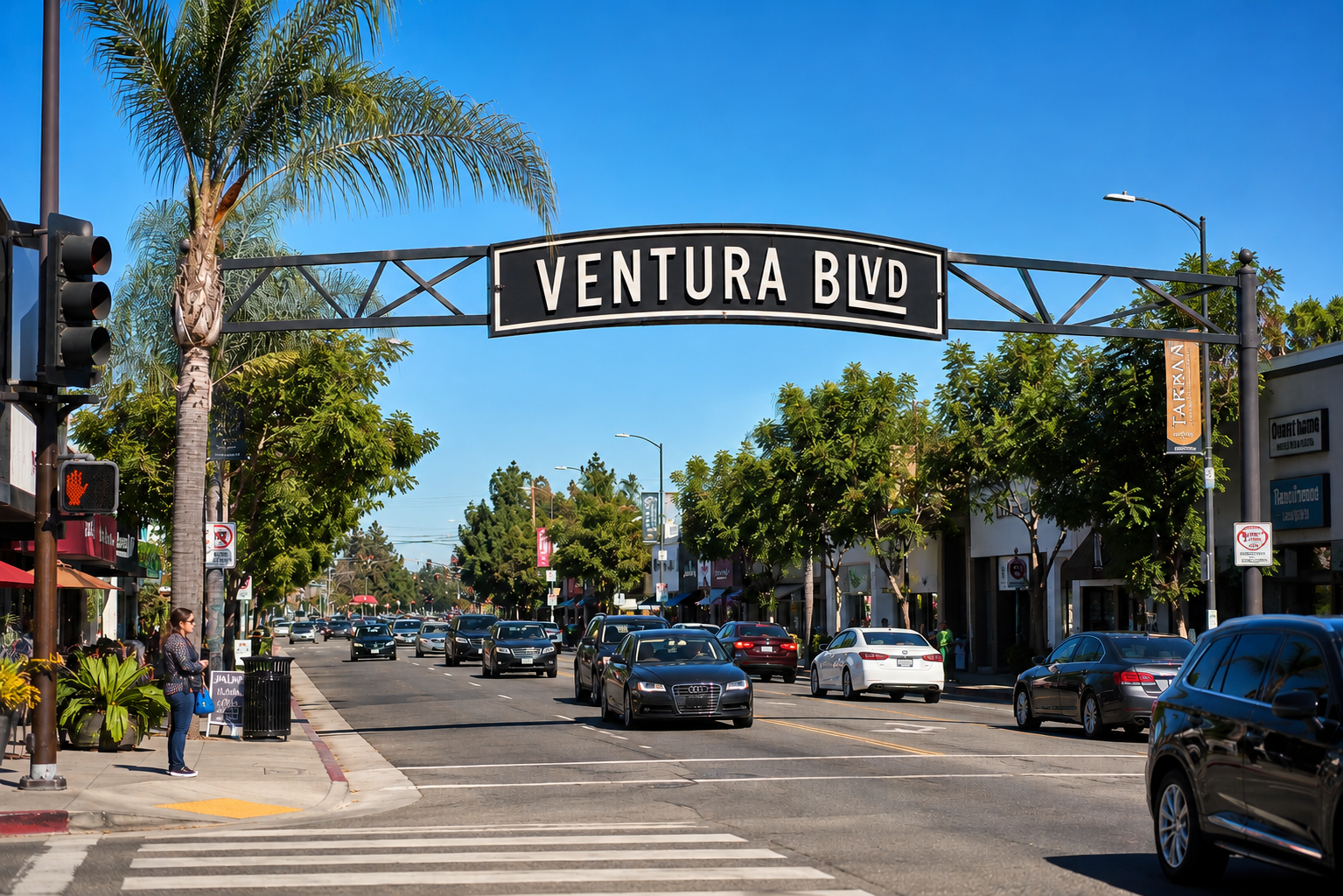
If you’re buying in Sherman Oaks, the most consequential decision you’ll make has nothing to do with square footage or finishes. It’s which side of Ventura Boulevard you land on. The boulevard doesn’t just bisect the city geographically — it defines two entirely different lifestyles, price points, and buyer profiles.
South of Ventura Boulevard offers hillside privacy and panoramic valley views. It features canyon access and iconic mid-century modern homes. Entry-level pricing starts around $2M.
North of Ventura Boulevard delivers larger flat lots and walkable, tree-lined streets. It maintains a strong community identity. More accessible entry pricing starts around $1.2–$1.3M.
Topography is the single biggest differentiator. Specifically, the south side is 80% ridgeline or canyon. Conversely, the north side is flat, with typical lot sizes of 6,750 square feet.
South of the boulevard favors privacy-seekers, couples, and empty nesters. These buyers prioritize views and architectural character.
North of the boulevard is the stronger choice for growing families. These buyers value community, school proximity, and room to grow.
The geography alone explains most of the lifestyle differences.
South of Ventura Boulevard, approximately 80% of the land sits within the Santa Monica Mountains. Properties are positioned along high ridgelines with sweeping valley views. Additionally, many homes are tucked into quiet canyons for a lush, natural setting. However, that quiet comes with trade-offs. You must consider hillside ordinances, slope band analysis, drainage, and retaining walls. For example, a 10,000 square foot lot on an upslope may yield only 3,000 square feet of functional yard space.
North of the boulevard, the terrain is essentially flat. Standard lots from the 1930s and 1940s typically measure 6,750 square feet. Furthermore, oversized lots in the 10,000–11,000 square feet range exist throughout the flats. What you see on paper is exactly what you get. You receive usable, level land without complicated hillside restrictions.
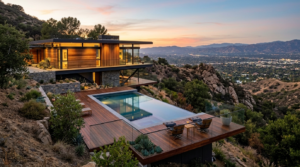
South of the Boulevard is home to some of the most significant architectural properties in the San Fernando Valley. Mid-century modern homes define the hillside aesthetic. These post-and-beam structures feature walls of glass opening to panoramic views. Renowned architects like Richard Dorman and Rodney Walker produced exceptional work here. Consequently, entry-level pricing on the south side begins around $2M for a home in good condition. Trophy properties in Longridge Estates easily reach $6M–$10M.
North of the Boulevard carries a very different character. It features the classic 1950s ranch home, built in large numbers by developer William Mellenthin. These homes feature diamond pane windows, cupolas over the garage, and rich wood detailing. In addition, they sit on generous, flat lots. Entry-level pricing here starts closer to $1.2M–$1.3M. However, brand new construction in desirable pockets can reach $4M–$5M.
Budget-wise, a comparable spend is possible on either side. Therefore, the real distinction is what your money buys. You can choose architectural drama and privacy to the south. Alternatively, you can choose lot size, flexibility, and neighborhood access to the north.
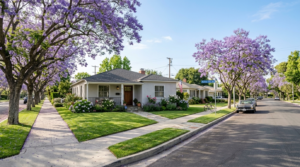
South of Ventura Boulevard is quieter in every sense. There is less foot traffic, less freeway noise, and fewer sirens. The streets through the canyons are winding and intimate. Additionally, residents enjoy direct access to established hiking trails. These include Deervale Canyon Park, Dixie Canyon Trail, and Fryman Canyon. Community exists here, but it is self-selecting. Neighbors are known by choice rather than proximity.
North of Ventura Boulevard is a fundamentally different social environment. Beautiful, tree-lined streets form the backdrop for an active pedestrian culture. By late afternoon, the sidewalks fill with dog walkers and busy families. Block parties are very common here. As a result, the community feels lived-in and deeply connected. For buyers with young children, this neighborhood environment is difficult to replicate in the hills.

Both sides of the boulevard have access to strong educational options.
South of the boulevard, private options include the Buckley School. Additionally, Campbell Hall and Carpenter Elementary sit in adjacent Studio City. Highly rated public choices include Sherman Oaks Elementary and Dixie Canyon Elementary.
North of the boulevard, Louis Armstrong Middle School is well-regarded for its STEM and performing arts programs. Notre Dame High School sits in the flats north of the boulevard. Private school options including Buckley, Campbell Hall, and Harvard-Westlake (middle school campus in Beverly Hills Post Office) are accessible from both sides.

South of the boulevard provides a natural advantage for commuters. If you regularly head over the hill to West LA, Century City, or the South Bay, this matters. The key canyon corridors—Coldwater Canyon, Beverly Glen, and Woodcliff—are your primary access points. Therefore, your specific location inside the canyons will materially affect your commute time. Properties near the mouth of the canyons reduce that daily friction considerably.
North of the boulevard offers much faster access to the 101 Freeway for east-west valley travel. However, if you head south over the hill regularly, you must factor in the extra transit time across the flats.
One important caution north of the boulevard: not all pockets are equal. Streets that function as cut-throughs between major arteries carry more congestion. Consequently, they tend to hold value less effectively. On the other hand, well-designed pockets offer great insulation. The “M Street” neighborhood features limited entry points, which eliminates heavy traffic throughput.
The buyer profiles are incredibly consistent.
South of the boulevard tends to attract couples, single buyers, or empty nesters. These individuals prioritize privacy, views, and architectural distinction over neighborhood proximity. In fact, buyers earlier in their careers often purchase south for the lifestyle, then migrate north as their family needs expand.
North of the boulevard is where families put down long-term roots. The combination of flat lots, community infrastructure, and school access makes it a highly durable choice. Additionally, massive new construction activity near the Studio City boundary reflects sustained demand from these buyers.

Migration patterns in Sherman Oaks follow a recognizable arc. Younger buyers enter south of the boulevard for the aesthetic appeal. Next, they move north when family growth demands flat yards.
For buyers evaluating total cost, the math bears close examination. Purchasing an undersized home frequently results in a forced sale within a few years. That mistake burns well over $100,000 in transaction costs, moving fees, and disruption. Therefore, buying for where your life is headed over a five-to-ten-year horizon is the more cost-effective strategy.
Alan Taylor has spent nearly 20 years and approximately 500 transactions helping buyers navigate exactly this decision in Sherman Oaks, Studio City, and throughout the San Fernando Valley. Whether you’re weighing hillside privacy against neighborhood community or evaluating specific streets and pockets, the right guidance at this stage saves significant time and expense later.
Contact Alan Taylor | Compass Real Estate 📞 818-217-1767
Available for private buyer and seller consultations. Reach out directly to discuss your specific criteria, timeline, and neighborhoods — no pressure, no obligation.